


What is Monolithic Architecture?
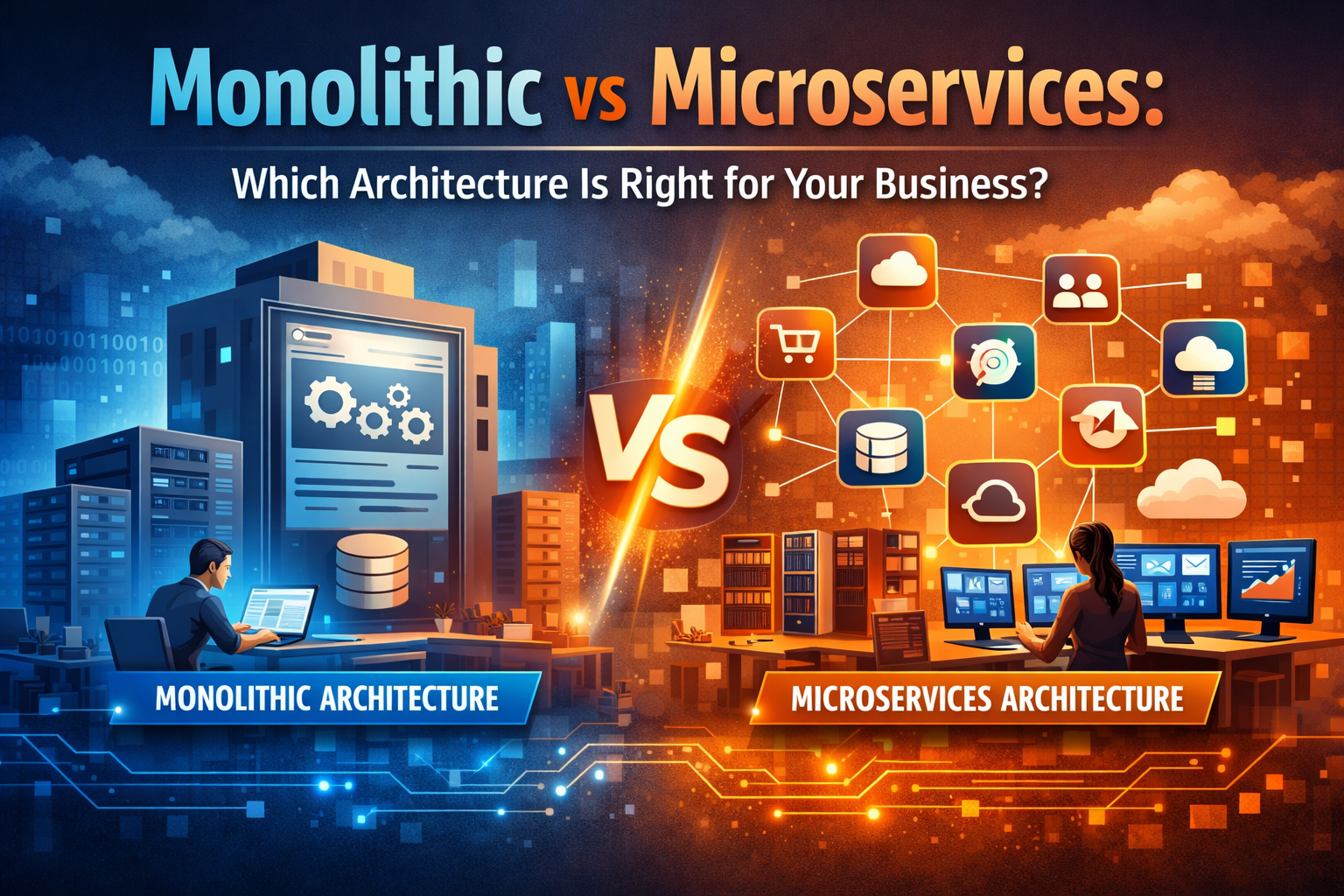
A Monolithic Architecture is a traditional software development model where all components of an application are built as a single, unified system. The user interface, business logic, and data access layers are all tightly integrated into one codebase and deployed together as a single unit.Key Characteristics of Monolithic Architecture
- Single Codebase: All functionalities exist within one application.
- Unified Deployment: The entire application is deployed at once.
- Shared Database: All modules typically access the same database.
- Centralized Management: Easier to manage in the early stages of development.
Advantages of Monolithic Architecture
- Simpler Development Process Monolithic systems are easier to develop and deploy initially because everything is contained within one project.
- Lower Initial Cost For startups or small applications, a monolithic structure requires fewer resources and less infrastructure.
- Easier Testing Since all components are integrated, testing can be straightforward.
- Faster Early Development Teams can build features quickly without managing multiple services.
Limitations of Monolithic Architecture
- Limited Scalability Scaling requires deploying the entire application rather than individual components.
- Difficult Maintenance Over Time As the application grows, the codebase becomes complex and harder to manage.
- Slower Updates Even small changes require redeploying the entire application.
- Technology Lock-in Using different technologies for different components becomes difficult.
What is Microservices Architecture?
Microservices Architecture breaks an application into smaller, independent services that communicate with each other through APIs. Each microservice handles a specific business function and can be developed, deployed, and scaled independently.Key Characteristics of Microservices Architecture
- Independent Services: Each service performs a specific function.
- Independent Deployment: Services can be updated without affecting others.
- Decentralized Data Management: Each service can manage its own database.
- Technology Flexibility: Different services can use different technologies.
Advantages of Microservices Architecture
- High Scalability Individual services can be scaled independently based on demand.
- Faster Development Cycles Multiple teams can work on different services simultaneously.
- Improved Fault Isolation If one service fails, it does not necessarily bring down the entire system.
- Technology Flexibility Teams can choose the most suitable technology stack for each service.
Challenges of Microservices Architecture
- Higher Complexity Managing multiple services requires advanced infrastructure and monitoring.
- Increased Development Cost Setting up service communication, containerization, and orchestration adds complexity.
- Deployment Management Requires tools like Docker, Kubernetes, or cloud orchestration platforms.
- Data Consistency Challenges Managing data across multiple services can be complex.
Monolithic vs Microservices: Key Differences
| Feature | Monolithic Architecture | Microservices Architecture |
| Structure | Single unified application | Multiple independent services |
| Scalability | Scale entire application | Scale individual services |
| Deployment | Single deployment unit | Independent deployments |
| Development Speed | Faster initially | Faster in large teams |
| Complexity | Lower complexity | Higher complexity |
| Flexibility | Limited technology flexibility | High flexibility |
When Should You Choose Monolithic Architecture?
Monolithic architecture is a good choice if:- You are building a small or medium-sized application
- Your development team is small
- You want faster initial development
- The project does not require complex scalability
- You want simpler infrastructure management
When Should You Choose Microservices Architecture?
Microservices architecture is ideal if:- You are building a large-scale or enterprise-level application
- Your platform requires high scalability
- Multiple teams are working on different system components
- You need frequent updates and independent deployments
- Your application must support millions of users